Speaking Tips
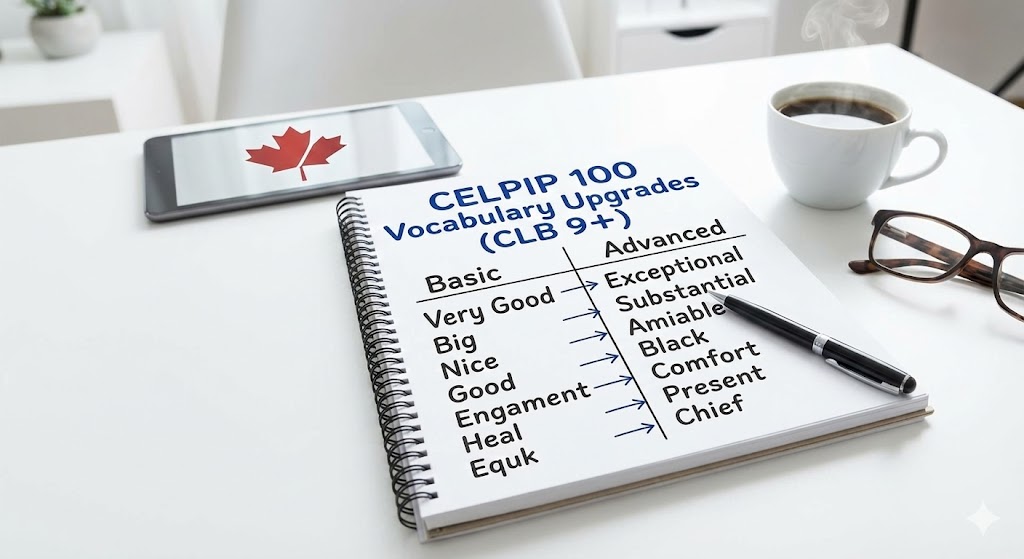
100 Vocabulary Upgrades to Hit CLB 9+ in CELPIP Speaking & Writing
Stop repeating the same vague words. Here are 100 task-grouped vocabulary swaps for CELPIP Speaking and Writing—aim for precision and range, not complexity for its own sake.
You're in the Speaking test. The prompt asks about a person you admire.
You freeze. The person is "good," "nice," and "works hard." That is all you can reach for under pressure.
Raters hear the same high-frequency words from many candidates. Range and precision are what make an answer memorable.
Mentor note: Under exam pressure, even strong learners default to basic words. Strong CELPIP-oriented answers show vocabulary range + precision—the word that fits the situation, not the rarest one you half-remember.
This is not about memorizing 100 words overnight. It is about strategic swaps in real time. Internalize 20–30 items you can say and spell confidently; that alone often sharpens how your performance reads on coherence and lexical range in prep feedback.
The three rules of test-day vocabulary
- Precision over complexity — If you are unsure how to pronounce or use a word, use the simpler one you own. A wrong collocation hurts more than a plain word.
- Vary intensifiers — Swap "very + adjective" for one stronger adjective when you truly mean it.
- Task-fit verbs — Different tasks reward different verbs (e.g. prediction vs. problem-solving). Match the verb to the job of the task.
The list below groups words by situation, not alphabet—easier to rehearse.
Group 1: Describing people and emotions (Tasks 1, 2, and 8)
When you will use this: personal opinions, describing people you know, relationship narratives.
Instead of: "nice," "happy," "sad," "bad"
| Word | Meaning | Example |
|---|---|---|
| Amiable | Friendly | "My mentor has an amiable personality." |
| Gregarious | Sociable, loves groups | "She's gregarious and always organizes team events." |
| Exhilarated | Very happy/excited | "I was exhilarated when I got the job offer." |
| Ecstatic | Overjoyed | "They were ecstatic about the promotion." |
| Apprehensive | Worried, nervous | "He felt apprehensive before the presentation." |
| Agitated | Annoyed, upset | "The customer became agitated with slow service." |
| Courteous | Polite, respectful | "A courteous response can defuse tension." |
| Empathetic | Understanding others | "Good managers are empathetic listeners." |
| Resilient | Strong in tough times | "Resilient people bounce back from failure." |
| Industrious | Hard-working | "She's industrious and always meets deadlines." |
Group 2: Describing places and scenes (Task 3)
When you will use this: picture descriptions, comparing environments.
Instead of: "green," "big," "small," "nice"
| Word | Meaning | Example |
|---|---|---|
| Picturesque | Beautiful, scenic | "The village had picturesque views." |
| Vibrant | Full of energy/color | "The market was vibrant and bustling." |
| Lush | Green, healthy plants | "The garden had lush vegetation." |
| Cramped | Small, crowded | "The office was cramped with no space." |
| Spacious | Big, open | "Their new home is spacious and bright." |
| Cluttered | Messy, disorganized | "His desk was cluttered with papers." |
| Bustling | Busy, full of people | "The streets were bustling with activity." |
| Tranquil | Quiet, peaceful | "The park offered a tranquil escape." |
| Dilapidated | Old, broken down | "The building was dilapidated and unsafe." |
| Symmetrical | Balanced, even | "The garden had symmetrical flower beds." |
Group 3: Comparing options (Task 5)
When you will use this: weighing pros and cons, recommendations, pivot-style reasoning.
Instead of: "better," "worse," "cheaper," "more expensive"
| Word | Meaning | Example |
|---|---|---|
| Superior | Better, higher quality | "The superior option has longer durability." |
| Economical | Cheap, good value | "The economical choice costs less upfront." |
| Exorbitant | Extremely expensive | "The ticket prices are exorbitant." |
| Invaluable | Extremely useful | "Her advice proved invaluable." |
| Compelling | Strong, persuasive | "The business case was compelling." |
| Drawback | Disadvantage | "The main drawback is limited flexibility." |
| Asset | Advantage, benefit | "His experience is a real asset." |
| Pragmatic | Practical, realistic | "A pragmatic approach beats idealism here." |
| Innovative | New, original | "Their innovative solution impressed us." |
Group 4: Opinion and advice words (Task 1 and writing)
Instead of: "I think," "I believe," "I feel"
| Word | Meaning | Example |
|---|---|---|
| Contemplate | Think deeply about | "I contemplate the long-term impact." |
| Envisage | Imagine the future | "I envisage two scenarios." |
| Advocate | Support or recommend | "I advocate for this approach." |
| Concur | Agree | "I concur with that assessment." |
| Dispute | Disagree | "I dispute that conclusion." |
| Speculate | Guess or hypothesize | "We can speculate about causes." |
| Assert | Say confidently | "I assert that this is the best option." |
| Ascertain | Find out for sure | "Let me ascertain the facts first." |
| Emphasize | Highlight, stress | "I emphasize the importance of feedback." |
| Evaluate | Judge or examine | "We need to evaluate all options." |
Group 5: Size and quantity (all tasks)
Instead of: "a lot," "some," "small," "big"
| Word | Meaning | Example |
|---|---|---|
| Plethora | Lots of | "A plethora of options exist." |
| Multitude | Many | "A multitude of factors influence this." |
| Abundance | More than enough | "Resources are in abundance." |
| Substantial | Significant or large | "There's a substantial difference." |
| Negligible | Too small to matter | "The risk is negligible." |
| Minute | Tiny (pronounced my-NOOT) | "The changes were minute." |
| Sparse | Scattered, thin | "Vegetation was sparse in the desert." |
| Incessant | Never-stopping | "The incessant noise was distracting." |
| Occasional | Sometimes | "Occasional updates are needed." |
Group 6: Action verbs for problem-solving (Task 8)
When you will use this: handling challenges, proposing solutions.
| Word | Meaning | Example |
|---|---|---|
| Endeavor | Try hard | "I'll endeavor to find a solution." |
| Navigate | Find your way through | "We navigated the budget crisis carefully." |
| Ameliorate | Improve, make better | "The new policy ameliorated the issue." |
| Exacerbate | Make worse | "Poor communication exacerbated the problem." |
| Collaborate | Work together | "We collaborated with other teams." |
| Implement | Start using a plan | "We implemented the new system." |
| Facilitate | Make easier | "This tool facilitates faster processing." |
| Utilize | Use | "We'll utilize existing resources." |
| Modify | Change | "We'll modify the schedule slightly." |
Group 7: Transition words (coherence)
High return on effort for writing and structured speaking.
| Word | Meaning | Example |
|---|---|---|
| Consequently | As a result | "Consequently, we changed our approach." |
| Furthermore | Also, in addition | "Furthermore, this saves time." |
| Conversely | On the other hand | "Conversely, some prefer the old method." |
| Nevertheless | However, but | "Nevertheless, we proceeded." |
| Simultaneously | At the same time | "Simultaneously, demand increased." |
| Subsequently | Afterward | "Subsequently, we reviewed the data." |
| Primarily | Mostly | "The issue was primarily a timing problem." |
| Particularly | Especially | "This is particularly relevant for startups." |
| Hence | Therefore | "Hence, we adopted a new strategy." |
Group 8: Intensifiers (replace "very")
Instead of: "very good," "very bad," "very big"
Use one strong word when it is accurate—not as decoration.
| Word | Intensity |
|---|---|
| Exceedingly | Very |
| Remarkably | Very |
| Incredibly | Very |
| Exceptionally | Very |
| Utterly | Completely |
| Thoroughly | Completely |
| Extremely | Very |
| Slightly | A little |
| Notably | Worth noticing |
| Deeply | Intensely |
Group 9: Professional writing phrases (writing tasks)
| Phrase | Use case |
|---|---|
| With reference to | Formal opening |
| In light of | Considering the facts |
| Taking into account | Acknowledging factors |
| For instance | For example |
| As a consequence | As a result |
| Regarding the matter of | About the topic |
| Expressing concern about | Stating worry |
| Proposing a solution | Suggesting an answer |
| Submitting a request | Making an ask |
| Kindly consider | Polite request |
Group 10: Abstract nouns (ideas and policy, Task 2 and writing)
| Word | Meaning | Example |
|---|---|---|
| Prosperity | Success, wealth | "Economic prosperity benefits everyone." |
| Adversity | Hardship, difficulty | "Adversity builds character." |
| Infrastructure | Systems, buildings | "Better infrastructure improves quality of life." |
| Sustainability | Long-term viability | "We must prioritize sustainability." |
| Viability | Ability to work | "This plan lacks viability." |
| Incentive | Motivation | "Tax incentives encourage investment." |
| Discrepancy | Difference, error | "There's a discrepancy in the data." |
| Efficacy | Effectiveness | "The drug's efficacy is proven." |
| Efficiency | Speed, productivity | "We improved efficiency by 30%." |
| Innovation | New ideas | "Innovation drives progress." |
Advanced: word recall under pressure
Why good words vanish mid-test: under timer pressure, your brain reaches for high-frequency defaults ("good," "thing") while fluency eats working memory. Low-frequency words need deliberate rehearsal in context.
Chunking + rotation
- Chunking: learn by situation (the groups above), not A–Z lists.
- Rotation: pick 5–7 words per two-week block; use each daily in a short speaking or writing answer.
Example block for Task 8: navigate, facilitate, implement, exacerbate, ameliorate, collaborate, endeavor.
7-day vocabulary rotation challenge
- Pick one group (for example Group 3: comparing options).
- Pick five words from that group.
- For seven days, use each word at least once per day in speaking or writing practice.
- One day per week, record (or write) one answer that uses all five in a single response.
- After seven days, move five new words—or deepen the same five in harder prompts.
Expected outcome: after a few cycles, a small set becomes automatic instead of "list you once read."
Myth: "I should memorize all 100 words and pack them into one answer."
Reality: A few precise words used naturally usually reads better than ten awkward ones. Integration beats count.
Myth: "Rare words always impress."
Reality: Mispronunciation or wrong collocation costs you. Prefer a word you can produce over a word you only half-know.
Key takeaway
Vocabulary is leverage: precision, range, and clean coherence. Build a small active set, rotate it in timed practice, then widen the set once the first block feels automatic.
Next steps
- Start with Group 3 or Group 6 depending on your weakest task type.
- Run the 7-day rotation above.
- Apply words in Speaking practice and Writing practice.
- Pair with the CELPIP Writing pivot technique for Task 2 structure.